EUR/USD analysis today: 1 setup became active at 1.11919, 4 November 2026
Data as of 2026-11-03 21:59 UTC · Levels and zones: Znorva analysis engine
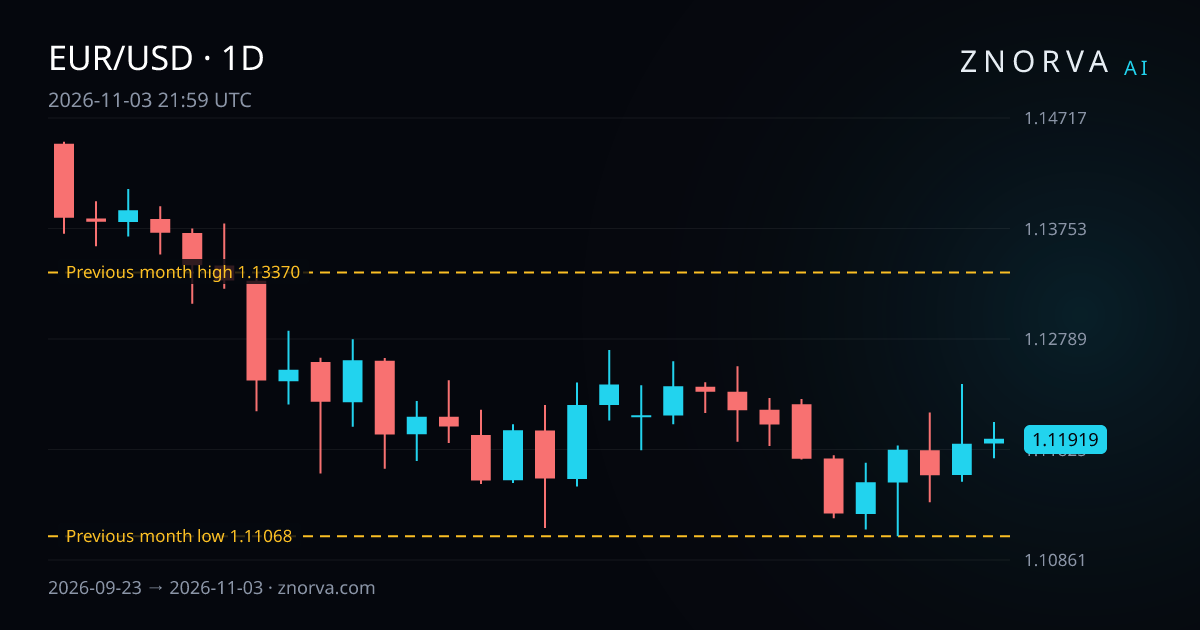
EUR/USD analysis today starts with one clear fact: a model setup became active at a reference price of 1.11919. The pair finished 3 November 2026 with a daily close of 1.11919, up 0.04% on the day. Data timestamp: 2026-11-03 21:59 UTC.
EUR/USD price snapshot
EUR/USD traded in a tight daily range on 3 November 2026. The session opened at 1.11877, reached 1.12064, fell to 1.1175, and ended with a daily close at 1.11919. That left the day higher by 0.04%, with a total range of 0.28%.
The previous session on 2 November 2026 was much wider. It opened at 1.11603, printed a high of 1.12397, touched 1.11543, and closed at 1.11875. The latest close was only slightly above that level, even after the wider swing on the day before.
The 7-session view from 26 October 2026 to 3 November 2026 still shows a softer short-term move. Over that stretch, EUR/USD opened at 1.1222, reached 1.12397, traded down to 1.11068, and closed at 1.11919. The net change across those sessions was -0.27%.
The wider 30-session range from 23 September 2026 to 3 November 2026 ran from 1.11068 to 1.1451. That keeps the latest daily close closer to the lower part of the broader range than to the top.
Nearest reference levels and zones
The nearest reference levels below and above come from the current market map. All distances in this section are measured from the daily close of 1.11919.
- Previous month low on 1D: 1.11068, which is 0.76% below.
- Previous month high on 4H: 1.1337, which is 1.3% above.
- Previous week high on 4H: 1.12265, which saw a liquidity sweep again on 4 November 2026.
There are no demand zone or supply zone readings in this snapshot. There were also 0 new zones added in the last 48 hours.
That leaves the current structure simple. The main map is defined by the previous month low below, the previous month high above, and the recently swept previous week high sitting between them.
What changed since yesterday?
The daily close moved from 1.11875 on 2 November 2026 to 1.11919 on 3 November 2026. That was a 0.04% rise. The latest daily session covered a 0.28% range.
No listed reference level was touched in the latest 24-hour change window. On the model side, 1 setup became active, 1 setup resolved under the model's rules, and 2 setups were invalidated before becoming active.
The newest structural update in the feed is the repeated liquidity sweep of the 4H previous week high at 1.12265 on 4 November 2026. In this framework, a sweep shows where liquidity was taken, and the next check is whether price can reclaim a key level or keep moving away from it.
Model-tracked outcomes
Model-tracked outcomes are hypothetical analytical results, not executed trades or customer results. Znorva does not execute trades.
Over the last 30 days, the engine logged 7 setups that resolved under the model's rules. Out of those 7, 6 ended as partial outcomes and 1 resolved at the model's stop level. None reached its final target, and 0 resolved at breakeven. The net hypothetical model-tracked outcome across those resolved setups was 3.93 R.
R is the distance between the reference entry and the model's stop level. In simple terms, 1 R is the model's unit of risk for a setup.
The broader setup record also matters. In the 14-day invalidation window, 49 setups were invalidated before becoming active. In the 30-day setup window, 28 expired without becoming active. Right now, 0 setups are still tracked as in progress.
Recent resolved examples show how that 30-day total was built:
- 1H short-side scenario: became active at a reference price of 1.12036 on 3 November 2026 and resolved at the model's stop level on 4 November 2026 for -1 R.
- 15m long-side scenario: became active at a reference price of 1.1123 on 28 October 2026 and had a partial outcome on 28 October 2026 for +0.93 R after reaching target 1 (TP1).
- 15m long-side scenario: became active at a reference price of 1.11975 on 23 October 2026 and had a partial outcome on 26 October 2026 for +1.52 R after reaching target 1 (TP1).
- 1H short-side scenario: became active at a reference price of 1.12298 on 21 October 2026 and had a partial outcome on 21 October 2026 for +0.13 R after reaching target 1 (TP1).
- 30m long-side scenario: became active at a reference price of 1.12157 on 19 October 2026 and had a partial outcome on 19 October 2026 for +0.03 R after reaching target 1 (TP1).
This sample does not show a market producing full target runs in the recent window. It shows a market where partial outcomes were far more common than final-target outcomes.
How Znorva AI reads this market
Znorva's methodology starts with reference levels such as previous day, previous week, and previous month highs or lows. It then checks for a liquidity sweep and waits for a reclaim, which requires 2 completed closes back beyond the level. After that, the model tracks up to 3 targets and keeps both 7-day and 30-day context in view.
In the current EUR/USD reading, the sweep at 1.12265 is the latest structural event. With no demand zone or supply zone in the snapshot, the reading depends more on reference levels and on whether price can reclaim after that sweep.
For more background, see the guide to AI forex analysis, the broader AI chart analysis framework, and the cross-market recap for EUR/USD, GBP/USD, and gold.
FAQ
What does EUR/USD analysis today show right now?
It shows a daily close at 1.11919, a daily gain of 0.04%, and 1 model setup that became active at a reference price of 1.11919. It also shows a repeated liquidity sweep of the 4H previous week high at 1.12265.
Which nearest reference levels matter in this snapshot?
The nearest reference levels in the current map are the previous month low at 1.11068 and the previous month high at 1.1337. The most recent swept reference level is the 4H previous week high at 1.12265.
What does 3.93 R mean in the model recap?
It is the net hypothetical model-tracked outcome across 7 resolved setups in the last 30 days. R is the distance between the reference entry and the model's stop level.