previous day high and low trading guide to sweeps, reclaims, and reference levels
Data as of 2026-10-30 20:59 UTC · Levels and zones: Znorva analysis engine
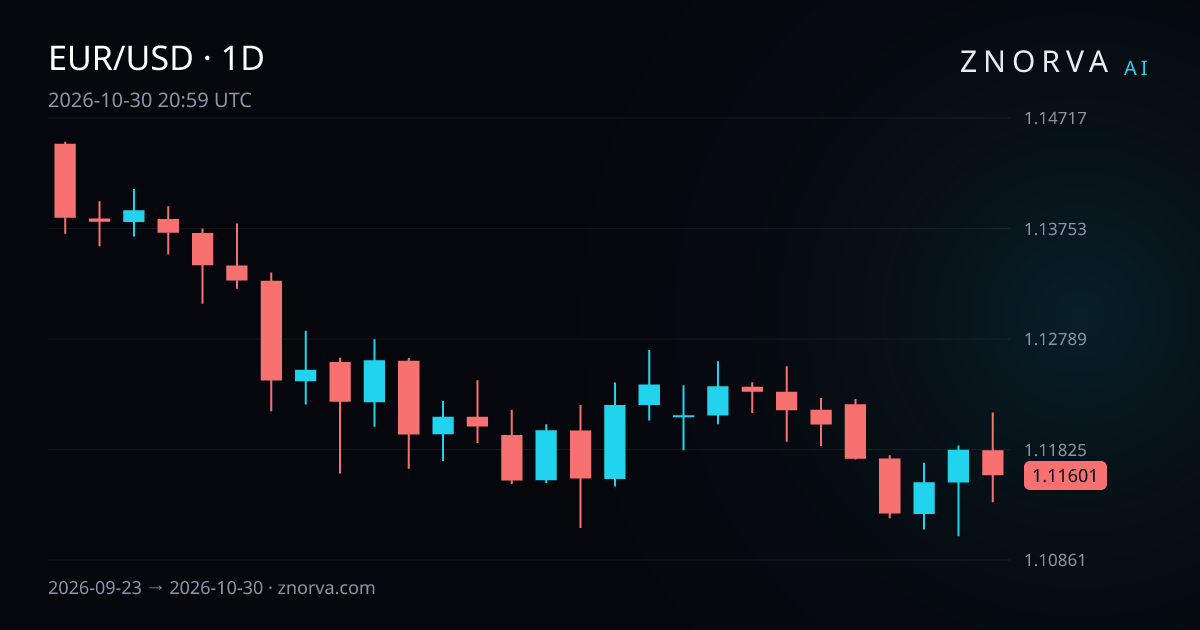
previous day high and low trading starts with two reference levels from the last completed day and a clear rule for how price returns to them. This guide explains the method, shows how Znorva AI tracks sweeps and reclaims, and uses data current to 2026-10-30 20:59 UTC.
What it is
This approach marks the previous day's high and low as reference levels. Traders then watch how price behaves when it comes back to those levels. A return can lead to rejection, acceptance, or no usable setup at all.
The same logic can extend to larger periods. A previous week high, previous week low, previous month high, or previous month low can matter when they sit close to the daily levels. That is why context matters as much as the line itself.
In Znorva's method notes, a liquidity sweep is the move through a known reference level before price tries to move back beyond it. A reclaim needs 2 completed closes back beyond that level. That rule helps filter out fast spikes that fail to hold.
The key idea is simple. A previous high or low is not enough on its own. The method waits for proof that price did more than tap a level.
How to spot it on a chart
Start with a clean chart and mark the last completed day's high and low. Then check the nearest reference levels from larger periods. If a daily level lines up with a weekly or monthly one, the area can carry more weight.
A simple chart routine looks like this:
- Mark the previous day high and the previous day low.
- Add the nearest reference levels from the previous week or previous month.
- Watch for a liquidity sweep through one of those levels.
- Wait for 2 completed closes back beyond the level to confirm a reclaim.
- After that, look for a demand zone for a long-side scenario or a supply zone for a short-side scenario.
This order matters. A sweep without a reclaim is only movement. A reclaim without a clear zone may still never become active under the model's rules.
If you want to see how the levels and zones are drawn on live charts, the chart library shows the same visual framework. For currency pairs, the forex archive uses the same reference-level logic.
How Znorva AI uses it (the method)
Znorva AI turns the chart idea into a fixed process. After a sweep and reclaim, the engine looks for an entry area in a set order: BPR first, then IFVG, then FVG. That priority stays the same across markets.
The model tracks 3 targets for each valid setup. It also measures the result in R. R is the distance between the reference entry and the model's stop level. If an outcome is -1 R, the setup resolved at the model's stop level. If price reaches a target, the outcome is measured against that same starting risk unit.
This keeps the method consistent. The engine does not treat every touch of a daily high or low as actionable. It waits for a liquidity sweep, a reclaim, and then the right zone in the right order.
That also explains why many scenarios never become active. Some are invalidated before the method confirms them. Others expire without the conditions lining up.
A real example from our data
A useful way to read the data is to separate reference levels from setup outcomes.
For EUR/USD, the engine tracked a previous month high at 1.16538 from 31 August 2026 to 30 September 2026. From the daily close of 1.11601 on 30 October 2026, that level was 4.42% above. That tells you the market was still below that higher-period reference level at the latest daily close.
Now look at a resolved setup. On BTCUSDT in crypto futures, a long-side scenario on the 15m timeframe became active at a reference price of 78,002.8 on 30 October 2026. It resolved under the model's rules on 30 October 2026 at 76,336.92. That means it resolved at the model's stop level, for a hypothetical model-tracked outcome of -1 R.
That example is useful because it shows the method without dressing it up. A clean structure can still fail to reach a target. The same rules appear on the Bitcoin pages, where the engine tracks the market with the same framework.
The broader sample adds context. In the last 60 days, 28 setups resolved under the model's rules. In that group, 1 reached target 1 (TP1), 12 had a partial outcome, and 15 resolved at the model's stop level. In the last 30 days, 313 scenarios were invalidated before becoming active.
Those counts highlight an important point. The method is selective. Most scenarios do not become active, and not every active setup reaches a target.
Common mistakes
One common mistake is treating every touch of the previous day high or low as meaningful. A touch is only a location. The model wants a liquidity sweep and then a reclaim.
Another mistake is ignoring larger context. A daily level can matter more when it sits near a previous week or previous month reference level. The EUR/USD example shows how a higher-period level can stay relevant even when price is still below it.
A third mistake is skipping the reclaim rule. If you do not have 2 completed closes back beyond the level, the reclaim condition is not complete. Without that step, the setup logic is incomplete.
The last mistake is overreading one outcome. A setup can become active and still resolve at the model's stop level, as the BTCUSDT example shows. That does not invalidate the method. It shows why outcome tracking matters across a full sample.
FAQ
Is previous day high and low trading only about daily levels?
No. The daily levels are the starting point, but the method also checks the nearest reference levels from the previous week and previous month. Those larger-period levels can change how important a daily sweep looks.
What confirms a reclaim in this method?
A reclaim needs 2 completed closes back beyond the reference level. That rule helps separate a true move back beyond the level from a brief spike that does not hold.
Can previous day high and low trading fail after a clean sweep?
Yes. The BTCUSDT example shows that a long-side scenario can become active after the required structure appears and still resolve at the model's stop level. Other scenarios never become active at all and are invalidated before the setup conditions are complete.