How To Read A Trade Setup Entry Stop And Targets: simple chart guide
Data as of 2026-10-13 23:59 UTC · Levels and zones: Znorva analysis engine
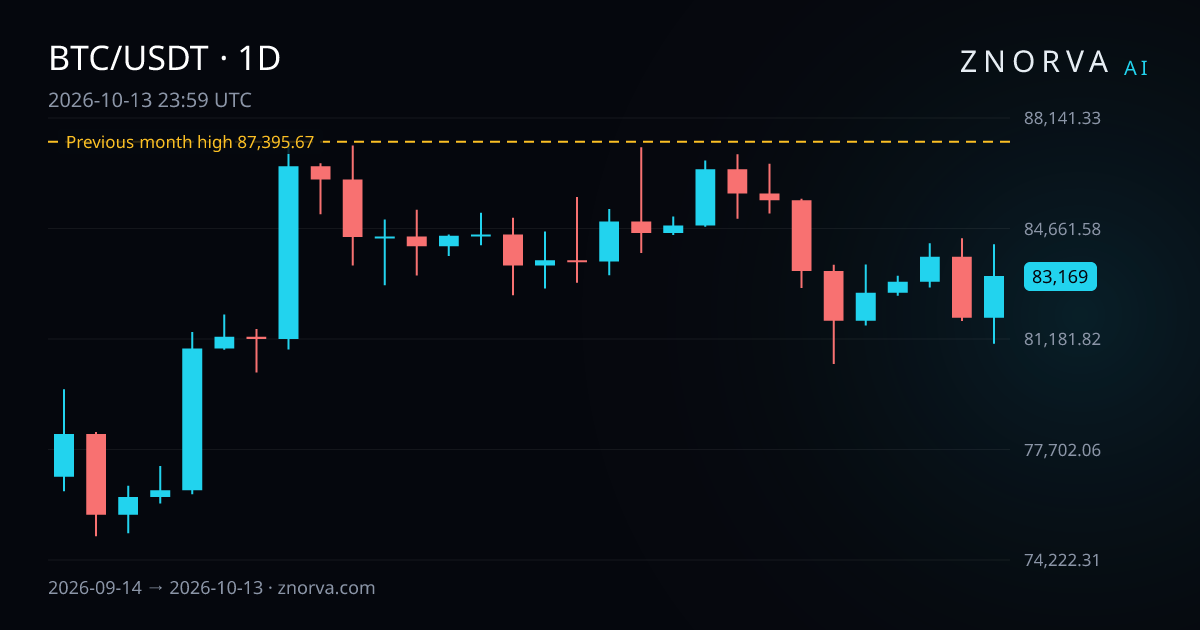
How to read a trade setup entry stop and targets starts with context. You need the reference level that caused the setup, the area where the scenario became active, the stop level, and the target map. This guide uses Znorva data with a timestamp of 2026-10-13 23:59 UTC. It shows the reading process in plain English, with one Bitcoin reference level and one resolved XAUUSD model setup.
What it is
A setup is an analytical scenario, not a standalone entry line. The entry, stop level, and targets only make sense when they are tied to a reference level and the move around it.
That context usually starts with the nearest reference levels. These are previous day, week, or month highs and lows. They matter because they show where liquidity can build and where a sweep may happen.
You also need to read outcome labels the right way. A setup can be invalidated before becoming active. If it does become active, it can later be resolved under the model's rules with a target reached outcome, a partial outcome, breakeven, or at the model's stop level.
The key idea is simple. Do not read the entry first. Read the structure first. Then the entry, stop level, and targets will make sense as one scenario instead of three random lines.
How to spot it on a chart
Start with the reference level and ask one question: did price sweep it? After that, look for a reclaim. In Znorva's method, a reclaim means 2 completed closes back beyond the level. The full rules are here: methodology.
Once the reclaim appears, mark the zone where the model prefers to see a return. Znorva ranks those entry areas in a fixed order: BPR first, then IFVG, then FVG. That order matters because the model prefers the cleanest area first.
Now read the setup in three parts:
- Entry: the reference price where the scenario became active if price returned as the model expected.
- Stop level: the point where the active scenario is resolved under the model's rules if the move fails.
- Targets: the 3 objective levels the model tracks after activation.
A clean setup links all three parts back to the same sweep and reclaim. If they do not connect to the same structure, the reading is weak. For a broader explanation of chart structure and level-based setups, see this guide to entries and stops.
How Znorva AI uses it (the method)
Znorva scans markets for sweeps of previous day, week, and month highs or lows. When a sweep appears, the engine waits for the reclaim condition. If the reclaim is confirmed, the model maps the preferred return zone and watches for activation.
R = the distance between the reference entry and the model's stop level (1 R). That makes outcomes easier to compare across markets because the model is not relying on raw price movement alone. A result of -1 R means the scenario resolved at the full model risk defined by that entry-to-stop distance.
The model tracks 3 targets for each active scenario. Not every valid setup reaches all 3. Some reach target 1. Some produce a partial outcome. Some resolve at breakeven. Some resolve at the model's stop level.
The value of the method is consistency. The same reading sequence applies across forex and crypto: reference level, sweep, reclaim, preferred zone, activation, then outcome. You can see that framework across Znorva's AI chart reading pages.
A real example from our data
First, look at a reference level example. On BTCUSDT, the engine marked Bitcoin's previous month high on the 1D timeframe. That level came from the period 1 September 2026 to 30 September 2026, and the level itself was 87,395.67.
From the daily close of 83,169 on 13 October 2026, that reference level sat 5.08% above. That tells you Bitcoin was still below that previous month high at the latest daily close. If you want to compare that with a live market page, see the Bitcoin market reading.
Now the setup example. On XAUUSD in the forex market, a long-side scenario on the 1H timeframe became active at a reference price of 4,175.89 on 13 October 2026. It resolved under the model's rules on the same day at the model's stop level. The model recorded 4,148.1 when it resolved, and the hypothetical model-tracked outcome was -1 R.
That example matters because it shows honest setup reading. A valid setup does not always reach a target. What matters is that the reference entry, stop level, and outcome all fit one model setup and are tracked the same way every time.
The wider record adds context. Over the last 60 days, 21 setups resolved under the model's rules. In that group, 4 reached a target, 5 produced a partial outcome, and 12 resolved at the model's stop level. Over the last 30 days, 624 scenarios were invalidated before becoming active. That tells you the model rejects many scenarios before it tracks one to completion.
Common mistakes
The first mistake is reading the entry, stop level, and targets without the reference level behind them. If you cannot point to the sweep and the reclaim, the rest of the setup becomes isolated chart marks.
The second mistake is ignoring the order of the preferred zone types. Znorva does not treat every return area the same way. It checks BPR first, then IFVG, then FVG. If you skip that order, you are no longer reading the setup the way the model does.
The third mistake is confusing invalidated setups with active setups that later resolved badly. An invalidated scenario never became active. The conditions were not met, so the model filtered it out before activation.
The last mistake is treating outcomes as all-or-nothing. Some setups reach a target. Some produce a partial outcome. Some resolve at breakeven. Some resolve at the model's stop level. Reading setups well means reading the label correctly instead of forcing one story onto every chart.
FAQ
What is the quickest way to read a setup on a chart?
Start with the nearest reference levels. Then check for a liquidity sweep, wait for the reclaim, and only then read the entry, stop level, and 3 targets. That order keeps the setup tied to the structure that created it.
Can how to read a trade setup entry stop and targets work the same way in forex and crypto?
Yes. The market context changes, but the reading sequence stays the same: reference level, sweep, reclaim, preferred zone, activation, and outcome.
Why do so many scenarios get invalidated before becoming active?
Because the model filters hard. In the last 30 days, 624 scenarios were invalidated before becoming active. That means the engine rejected them before activation instead of forcing a weaker setup.